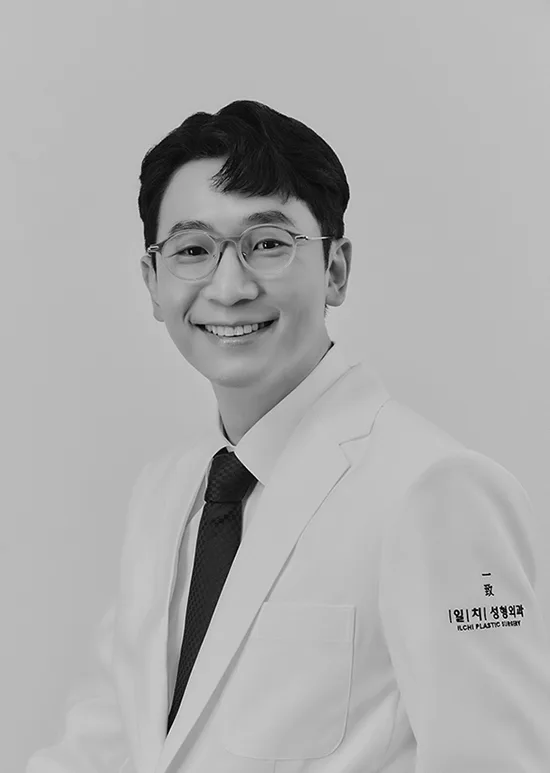
Dr. Hyung Suk Moon
Meet the plastic surgeon at ILCHI in Seoul: his medical background, direct training with Dr. Kao, research and approach to facial lifting.
Medical background
Dr. Hyung Suk Moon is a Korean board-certified plastic surgeon and Medical Director of ILCHI Plastic Surgery. He graduated from Kyung Hee University College of Medicine and trained in plastic and reconstructive surgery at Kyung Hee University Medical Center. His official profile also lists previous practice at Secret, DA and NOTE Plastic Surgery.
His name appears in research records as Hyung Suk Moon and in the clinic’s English profile as Moon Hyung-Suk. These spellings refer to the same physician. The research archive identifies his papers by title, coauthors and publication record.
Direct learning with Dr. Kao
Dr. Moon is one of Dr. Chia Chi Kao’s five students. His account of learning the Ponytail Lift describes three visits to the United States: Pittsburgh in 2025, Santa Monica in February 2026 and Boston in May 2026. Each visit addressed different questions about anatomy, surgical observation and refining his understanding.
Training is part of his background; the operation still has to fit the individual patient. In his patient education, Dr. Moon explains that he studies several approaches and adapts the principles to the face in front of him. Read his learning journey.
Start with what has changed
Dr. Moon’s patient education returns to a practical question: is the concern a change in tissue position, a change in volume, excess skin, or a combination? A person asking about a fold may need a different discussion from someone whose main concern is the neck. The label of a fashionable operation cannot answer that question on its own.
In younger patients, he sometimes asks for an older photograph the patient likes. This gives the consultation a personal reference: which features should be preserved, what has changed and what the patient means by looking refreshed. A photograph is a conversation aid, not a promise to recreate a face from a particular year.
Research and patient education
His published work includes premature-infant skin defects and hollow upper eyelids, with a separate conference abstract on complications after facial fat transfer. These are different research questions; none should be presented as his own Ponytail outcome series. His later interest in the midface is also represented in education and conference records.
Read the research and presentation archive or the signed columns and media index. The distinction between a paper, a conference abstract, a personally signed column and a journalist’s quotation matters when assessing a surgeon’s background.
Preparing for a consultation
The surgeon selection guide brings together questions about qualifications, training, procedure scope, outcomes and follow-up. Use it to discuss how the proposed plan fits your concerns.
Sources and further reading
Adapted from Dr. Moon’s patient education. Additional references are listed below where used.
Writing across two source accounts
The writing archive brings together 129 posts from Dr. Moon’s personal blog and 272 posts from the ILCHI clinic blog. Each has an individual English summary, its original publication date and a source link. The collection covers patient education, reported cases, professional reflections and academic activity.
The personal blog includes earlier posts naming Secret, DA and NOTE. Those affiliations belong to the historical source; the current practice is ILCHI. A clinic-account post is distinguished from a personally signed post, and an account of a meeting is distinguished from a published paper. Explore teaching and conference accounts alongside the bibliographic research record.
External professional records
The external records collection links official society publications and conference programmes with medical expert profiles and named press contributions. It also identifies examples of later papers citing Dr. Moon’s research. Each source is labelled by its role and date.